
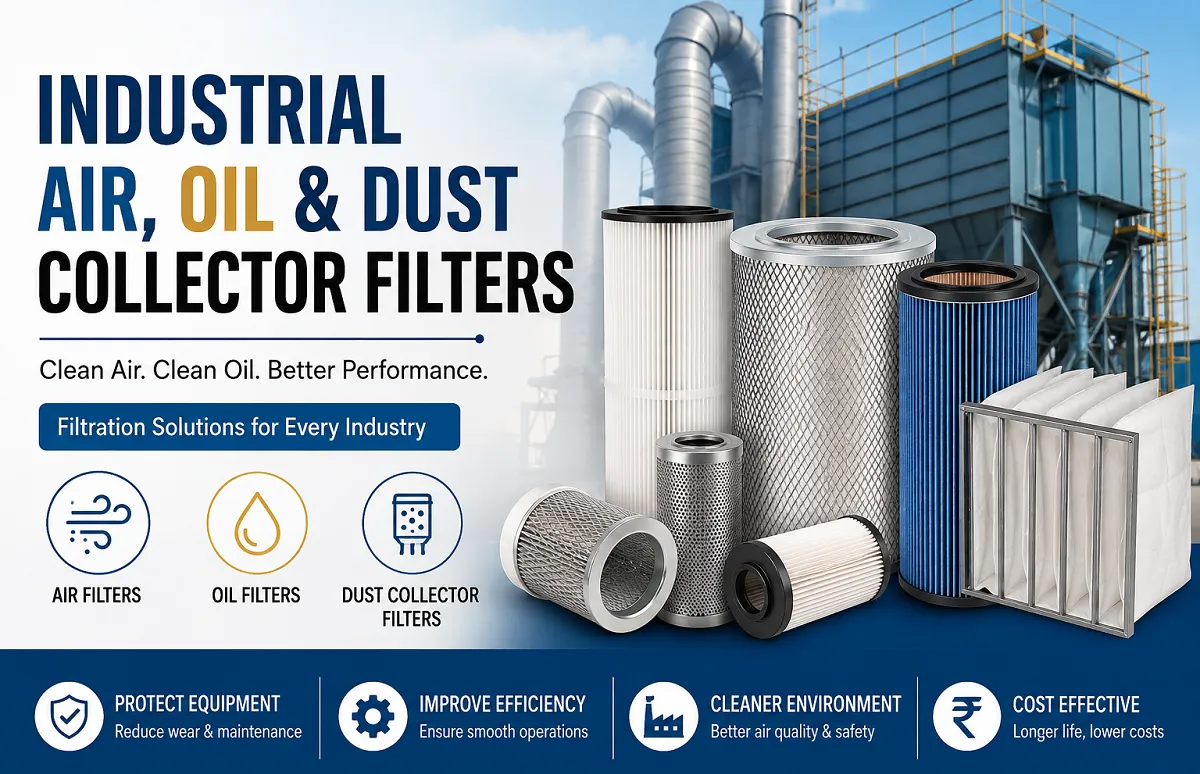
Industrial filtration plays an important role in keeping machinery, production systems and working environments running efficiently. Whether a business needs to manage airborne dust, protect hydraulic and lubrication systems, or improve air quality within an industrial process, selecting the right filter can make a significant difference.
Businesses in Hyderabad and across India operate in a wide range of sectors, including manufacturing, pharmaceuticals, chemicals, food processing, engineering, automotive, power generation and other industrial fields. Each application has its own filtration requirements.
For this reason, choosing the right air, oil, or dust collector filter supplier in Hyderabad involves more than simply selecting a product based on size or price.
The filter must be suitable for the application, operating conditions and type of contamination involved.
Understanding Different Types of Industrial Filters
Industrial filtration is not a one-size-fits-all solution. Different processes require different types of filters depending on what needs to be removed or controlled.
Three commonly required categories include:
- Air filters
- Oil filters
- Dust collector filters
Each serves a different purpose and should be selected according to the needs of the equipment or process.
Air Filters for Industrial Applications
Airborne particles can affect equipment, production processes and workplace conditions.
Industrial air filters are designed to capture particles from moving air. Depending on the application, these particles may include:
- Dust
- Fibres
- Fine particles
- Process-related contaminants
- Other airborne matter
The correct air filter depends on several factors.
Airflow Requirements
The filter must be capable of handling the required volume of air without creating excessive resistance.
A poorly matched filter may affect airflow and reduce the efficiency of the overall system.
Type of Contamination
The size and nature of airborne particles can influence the type of filtration media required.
Larger particles and finer contaminants may require different filtration approaches.
Operating Environment
Industrial environments can vary significantly.
A filter used in a relatively clean production area may have different requirements from one used in a dusty manufacturing environment.
Understanding the actual operating conditions can help businesses choose a more suitable solution.
Oil Filters and Equipment Protection
Oil filtration is commonly used in industrial machinery and systems that depend on clean hydraulic or lubricating fluids.
Over time, unwanted particles may enter the system through different sources, including:
- Wear of internal components
- External contamination
- Maintenance activities
- Process conditions
If contamination is not properly managed, it can affect sensitive components and increase maintenance requirements.
Oil filters may be used in applications involving:
- Hydraulic systems
- Lubrication systems
- Industrial machinery
- Pumps
- Equipment with moving components
The right filter should be selected based on the specific system requirements.
What to Consider When Choosing an Oil Filter
Several factors should be reviewed before selecting an industrial oil filter.
Filtration Requirement
The level of cleanliness required depends on the equipment and application.
A filter should provide suitable protection without creating unnecessary restrictions in the system.
Flow Rate
The filter must be capable of handling the required flow.
Incorrect sizing may lead to increased resistance or reduced system performance.
Operating Pressure
The filter and its components must be suitable for the pressure conditions of the system.
This includes considering both normal operating pressure and possible fluctuations.
Compatibility
The filter media, seals and other components should be compatible with the oil or fluid used in the system.
Providing complete application details to a supplier can help with selecting a suitable filtration option.
Dust Collector Filters for Industrial Environments
Dust is a common challenge in many manufacturing and processing facilities.
Depending on the industry, dust may be generated during:
- Cutting
- Grinding
- Mixing
- Material handling
- Powder processing
- Manufacturing operations
Dust collector filters are used as part of dust collection systems to capture particles from the air.
The requirements can vary depending on the characteristics of the dust and the design of the system.
Choosing the Right Dust Collector Filter
A dust collector filter should be selected based on the actual application rather than simply choosing a standard replacement.
Important factors may include:
- Type of dust
- Particle characteristics
- Airflow
- Operating conditions
- Filter dimensions
- Existing dust collection system design
- Required filtration performance
- Maintenance requirements
The physical characteristics of the dust can also affect filter selection.
For example, different applications may involve fine powders, fibrous materials or heavier particles.
Understanding these differences can help businesses select a filter that is better suited to their process.
Why Choosing the Right Filter Supplier Matters
A suitable industrial filter supplier should understand that different industries have different requirements.
Before recommending a product, it is useful to consider:
- What is being filtered?
- What type of contamination is present?
- What is the required flow rate?
- What pressure and temperature conditions are involved?
- What equipment needs protection?
- What are the existing filter dimensions?
- Are standard filters suitable?
- Is a customised filtration solution required?
Providing these details can help reduce the risk of selecting an unsuitable product.
Businesses may also benefit from working with suppliers that offer multiple industrial filtration options rather than trying to use the same type of filter for every application.
Air, Oil, and Dust Filtration for Different Industries
Industrial filtration requirements can differ across sectors.
Pharmaceutical Industry
Manufacturing environments may require filtration solutions that support controlled processes and help manage particulate contamination.
Chemical Industry
Chemical processing can involve different fluids and operating conditions, making material compatibility an important consideration.
Food and Beverage Processing
Filtration may be used at different stages of processing depending on the materials and equipment involved.
Manufacturing and Engineering
Air filters, oil filters and dust collector filters can be used to support equipment protection and manage process-related contamination.
Automotive Industry
Industrial filtration may be used in machinery, hydraulic systems, lubrication systems and manufacturing processes.
Power and Energy
Equipment operating in demanding conditions may require suitable filtration to manage contamination and protect critical components.
Common Mistakes When Selecting Industrial Filters
Choosing Based Only on Price
The lowest-priced filter may not always provide the most practical long-term solution.
Replacement frequency, maintenance requirements and compatibility should also be considered.
Ignoring Operating Conditions
Pressure, temperature and flow requirements can influence filter performance.
A filter that appears suitable based only on its physical size may not be suitable for the actual operating environment.
Selecting the Finest Available Filter
Finer filtration is not automatically better.
If the filter is too restrictive for the application, it may become blocked more quickly and affect system performance.
Using Incorrect Dimensions
Replacement filters should be checked carefully for dimensions, fitment and system compatibility.
Even small differences can affect installation or performance.
Delaying Filter Maintenance
As filters collect contaminants, their resistance to flow can increase.
Regular inspection and appropriate replacement can help avoid unnecessary operational issues.
Choosing an Industrial Filter Supplier in Hyderabad
When looking for an air, oil, and dust collector filter supplier in Hyderabad, it is helpful to choose a supplier that can understand the technical requirements of the application.
Before contacting a supplier, businesses should prepare information such as:
| Information | Why It Matters |
|---|---|
| Filter application | Helps identify the appropriate filter type |
| Type of fluid or air | Supports material selection |
| Contaminant type | Helps determine filtration requirements |
| Flow rate | Helps with correct sizing |
| Operating pressure | Ensures the filter can handle system conditions |
| Temperature | Supports suitable material selection |
| Existing filter dimensions | Helps identify replacement options |
| Equipment details | Helps understand protection requirements |
This information can make the selection process faster and more accurate.
Industrial Filtration Solutions from 3R Filters
For businesses looking for industrial filtration products and application-specific options, 3R Filters provides a range of filtration products for different industrial requirements.
Depending on the application, available product categories may include solutions related to:
- Industrial air filtration
- Hydraulic and lubrication filtration
- Dust collector filters
- Filter cartridges
- Filter bags
- Strainers
- Filter housings
- Other industrial filtration requirements
The right solution should always be selected based on the actual operating conditions and process requirements.
A discussion with an experienced filtration supplier can help businesses identify suitable options based on factors such as filter dimensions, flow requirements, filtration needs and the type of equipment involved.
Frequently Asked Questions
What types of industrial filters are commonly used in Hyderabad?
Depending on the industry and application, businesses may use air filters, hydraulic and oil filters, dust collector filters, cartridge filters, filter bags, strainers and other filtration products.
How do I choose the right dust collector filter?
Consider the type of dust, airflow requirements, existing system design, filter dimensions, operating conditions and maintenance requirements.
Why is oil filtration important for industrial equipment?
Oil filtration helps manage unwanted particles in hydraulic and lubrication systems. The appropriate filtration requirement depends on the equipment and operating conditions.
Can industrial filters be customised?
Some applications may have specific requirements related to size, materials, connections, filtration levels or operating conditions. In such cases, an application-specific solution may be considered.
What information should I provide when requesting an industrial filter?
Provide details about the application, material being filtered, type of contamination, flow rate, operating pressure, temperature and existing filter dimensions where available.
Conclusion
Air, oil and dust collector filters are used for different purposes, but they all need to be matched carefully to the application.
Choosing the right industrial filtration system requires an understanding of the material being filtered, contamination levels, operating conditions and equipment requirements.
For businesses searching for an air, oil, and dust collector filter supplier in Hyderabad, taking the time to provide accurate application details can help make the selection process more effective.
Instead of choosing a filter based only on price or appearance, focus on whether it is suitable for the actual system. Considering factors such as airflow, flow rate, pressure, temperature, contamination and maintenance requirements can help businesses select a filtration solution that better fits their operational needs.

The GetInfopedia Editorial Team creates informative and easy-to-understand content covering health and wellness, beauty, skincare, hair care, food, fitness, weight loss, lifestyle, fashion, travel, technology, online earning, and other general-interest topics.
The team focuses on researching information from reliable and relevant sources, presenting complex topics in a simple and practical way, and reviewing content when important information changes. Health, financial, career, and other sensitive topics are prepared with appropriate care and are intended for general informational purposes